 |
A
view of the Douglas Bridge near Inverary, Argyllshire
By
Patrick Nasmyth |
Wednesday, April 5, 2017
Patrick Nasmyth Paintings Geocoded
Patrick Nasmyth (1787–1831) paintings might be better termed "treescsapes" than landscapes. Even his paintings which have a landmark, and/or have a title that indicates the location of the view (a very large number are simply titled "Landscape"), the primary visual interest is in the foliage. Minutely detailed trees frame the view and generally obscure the horizon. Their backdrop are often dramatically lit clouds which are similar to the trees in their irregular shape and curvature, but are a bland shadow compared to the complex wonder that are the living things: stately yet dynamic; seemingly solid yet growing.

Monday, April 3, 2017
Alfred East Paintings Geocoded
Alfred East (1849–1913) partings have a muted hazy quality, without bright sunshine nor vivid colors nor deep shadows. The title of many of his works are not specific about their location; and in many of the works in which a place name is in the title, the image could in fact be any of a number of places. But for the artist there was something about the feel of the place that could be matched to its name.
Only a handful of his works have a structure or landmark that would unlikely identify the location, and these works do not make that feature the focus of the piece; in all cases the atmosphere or feel of the place is the focus (though generally out of focus).
Only a handful of his works have a structure or landmark that would unlikely identify the location, and these works do not make that feature the focus of the piece; in all cases the atmosphere or feel of the place is the focus (though generally out of focus).
In 1907 he published The Art of Landscape Painting in Oil Colour, a 193 page review of his approach to Grass, Skies, Trees, Reflection, etc, according to the chapter titles.
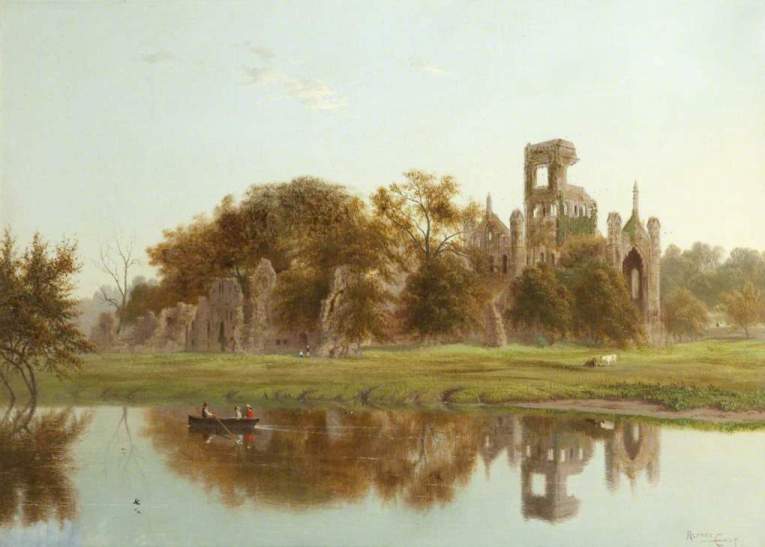 |
Kirkstall Abbey
By Alfred East
|
Wednesday, March 29, 2017
Thirty John Wilson Carmichael Paintings Geocoded
John Wilson Carmichael (1800-1868) paintings are a prime example of how a culture is reflected in what a painter chooses to capture (or what the artist believes he can find a market for). Like George Chambers, he reflects the sea-faring nature of his country, particularly showing the interface of land-based people and the ports and vessels they use to transcend their limits. Carmichael's body of work includes a couple of view of the British Navy destroying the the land interface of non-English places.
 |
| The
Brayford Pool
and Lincoln Cathedral by John Wilson Carmichael |
Wednesday, March 22, 2017
George Chambers Paintings in GeoCodedArt.com
George Chambers (1803-1840) painted maritime scenes with identifiable landmarks on shore. Rather than just show the majesty of a vessel at full sail mastering the open seas, his views make a connection between we land-based observers and the instruments that can carry us to all points on the globe. Harbors are of particular interest as the transition point for our modes of being.
 |
Entrance to Portsmouth Harbour
by George Chambers
|
Friday, March 17, 2017
Henry Pether Paintings Geocoded
Henry Pether (1828-1865) did a large number of paintings by moonlight, including some scenes where the same location was painted by day and by night. The subject of his dozens of paintings in moonlight were usually recognizable landmarks, almost evenly split between London and Venice. The silhouettes of well-known structures lends more of a story to the images than there would be if were a simple river scene by moonlight (a few of which he did). By and large, though, the works are identified by location, and have a intriguing air about them: without any other persons out at these hours, the viewer is left to imagine their own participation in the enchanting atmosphere.
 |
Marlow On Thames
by Henry Pether
|
Wednesday, March 15, 2017
George Cole Paintings in GeocodedArt.com
George Cole (1810-1883) paintings of outdoor scenes bear a strong resemblance to the work of his son, George Vicat Cole. The elder did more port scenes and landmark structures, though never with an eye to record impressive architecture. His handful of views around Windsor Castle seem just to be the location of pleasing countryside (a common trait in royal locations). The elder also worked in portraits an animal studies, but the wide open country views were his most common, and were the subject almost exclusively adopted by his son,
 |
| The London Road, Portsdown Hill by George Cole |
George Vicat Cole Paintings Geocoded
George Vicat Cole (1833-1893) painted almost exclusively outdoor scenes, and these only occasionally included any man-made structure, or any evidence of human presence. His works generally feature overcast skies, without direct sunlight, leaving the edges of most objects are a little blurred. Equally hazy are the specific locations of most of his scenes: the majority do not carry a title that would identify the spot of the pleasing "Country Life" or "Landscape with Sheep". They do all possess a far horizon, the sort of spot that would make a passerby to stop for a moment to consider what a pleasant land they were passing through.
 |
| On the Tamar, Devon by George Vicat Cole |
Subscribe to:
Posts (Atom)