Thursday, December 10, 2015

Sanford Robinson Gifford Paintings in GeocodedArt

South Bay on the Hudson, near Hudson NY


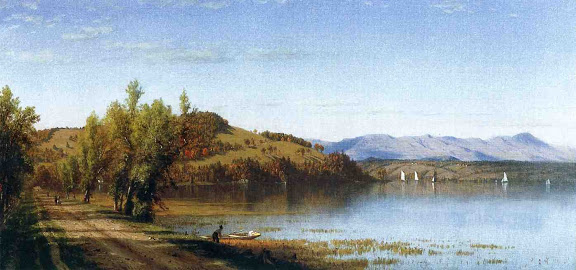
South Bay, on the Hudson, near Hudson, New York


Painted by Sanford Robinson Gifford (1823-1880). This is one of several works that Gifford (and others painters of the Hudson river school) did near the homes of Cole and Church, the earliest leaders of American landscape paintings. 
This view features a well-rutted road, a well farmed hillside, and a man handling a boat (the only common element you are likely to see there today). This work emphasizes the beauty of the ordinary, not the grand views or wild nature that have come to be regarded as the signature features of the Hudson River school. Gifford also traveled widely and captured sites with the same pleasing blend of light, color, and texture.


Sunday, December 6, 2015

Jasper Francis Cropsey Paintings in Geocoded Art


The Narrows from Staten Island


Painted by Jasper Francis Cropsey (1823-1900). Cropsey's many paintings in his native New York are most often studies in color more than topography or dramatic of water and sky. 
He tended to autumnal colors, even in this scene that must be late summer, judging by the foliage. 

Long before this site came to be dominated by the Bridge it provided the citizenry with a vista of the Hudson heading out to see and all that lay beyond. But the near features come in for detailed treatment, in the foliage and beaches on Long Island. Note even the shadows beginning to reach over the artist's shoulder.


Tuesday, December 1, 2015

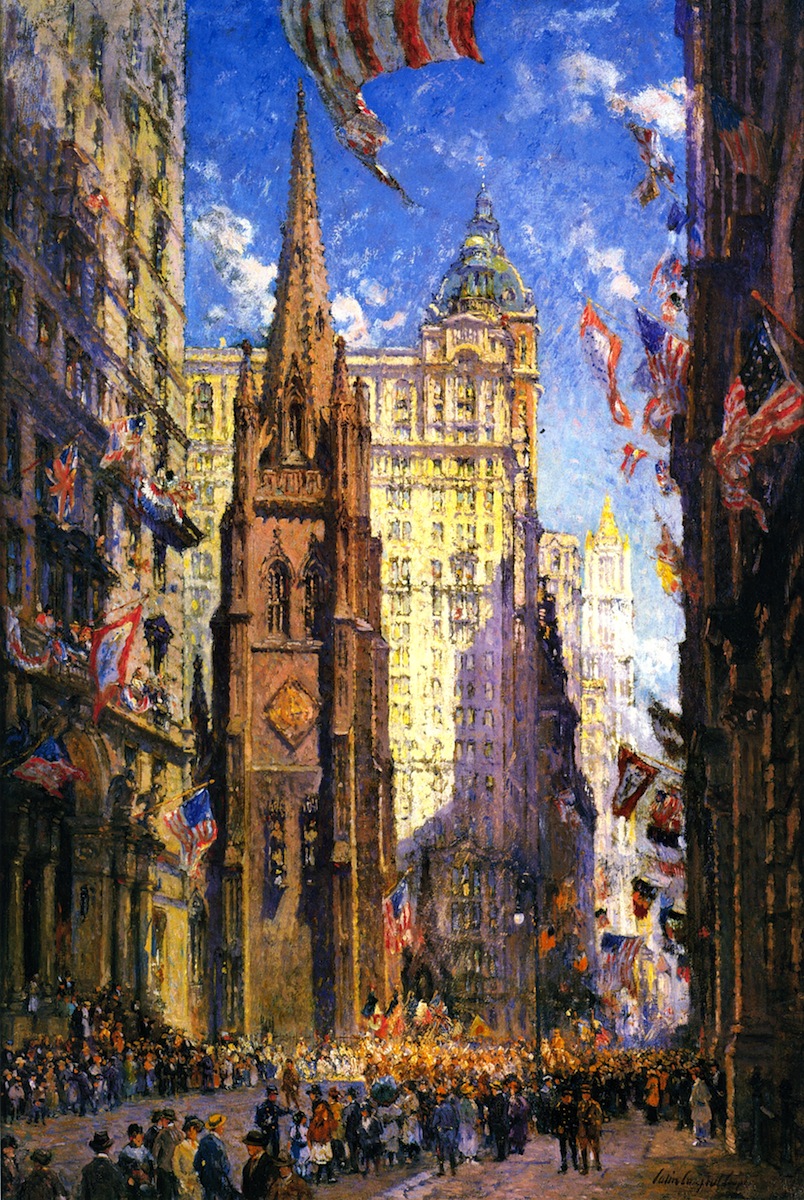
Colin Campbell Cooper paintings in GeoCodedArt


Painted by Colin Campbell Cooper (1856-1937).
Like other of Cooper's paintings of Manhattan, this image spills over with color and civic pride. He had done an earlier work of Trinity Church and the Trinity Building before completion of the distant tower, the Woolworth building, which was the tallest building in the world when it was completed. 


Three Towers

Wednesday, November 25, 2015

David Johnson Paintings Geocoded

View of the Hudson from Barrytown NY


Painted by David Johnson (1827-1908). The featureless sky was a device Johnson used frequently to keep the viewer's focus on the good Earth below. The foliage, as much as dramatic terrain, was an inspiration; there's not much to Barrytown today, other than beautiful sloping hillsides. But this image is a fine example of how the taking the artist's perspective can create an extraordinary view out of a seemingly ordinary place.


Monday, November 16, 2015

Francis Silva paintings in GeocodedArt

Kingston Point, Hudson River


Painting by Francis A. Silva (1835-1886).  Virtually all of Silva's paintings are focused on water; scenes of calm rivers greatly outnumber the seascapes,  and few of those have any measure of wave action.

He often painted boats with their sails full of wind, and seemingly full of promise. The ideal situation on the water appears to be a different world from the gritty bank where the observer stands, and to which the painter devoted a great deal of attention.


Monday, September 14, 2015

Cornelis Springer paintings in GeocodedArt

The Gemeenlandshuis and the Old Church, Delft, Summer


Painting by Cornelis Springer (1817-1891).  The last great master of the Dutch townscape, he re-covered a lot of the ground that others had made iconic hundreds of years before.  If there is anything that distinguishes these views as more nearly modern, it may be that the great towers that dominate the towns are in a slightly romantic soft focus; perhaps still reverenced if not worshiped for what they represent.  The activities in the street receive more detailed attention.


Sunday, August 16, 2015

Gerrit Berckheyde Paintings in GeoCodedArt

View of Amsterdam


Painting by Gerrit Adriaensz Berckheyde (1638-1698). A prolific painter of townscapes of Amsterdam and The Hague. He often painted the same buildings or neighborhoods from slightly different vantage points, but did very few interiors or imaginary scenes.  Compared to his contemporaries, he did not put much effort into realistic clouds, but frequently left facades of buildings in shadow, heightening the realism of the view.